• Home
  • About
    • Profile
    • Statement
  • Artwork
  • Critic
  • Article
  • Exhibition
  • Artfair
RIMM


The Good Earth 
 Ottchil (Korean natural lacquer), Hemp cloth, 
Hanji(Korean mulberry paper) on wood 
 60x70cm 
 2026
 

The Good Earth 
 Ottchil (Korean natural lacquer), Hemp cloth, 
Hanji(Korean mulberry paper) on wood 
 60x70cm 
 2026

“The layered ridges above the yellow transform into luminous spaces as various color strips overlap, connect, and meet at their edges. Each color strip retains its distinct character, yet also follows the harmonious ways of nature.
Each element comes together while preserving its own distinct character, and difference remains within that unity, unfolding a richer resonance of color.”
-Excerpt from the Artist’s Statement
  
Share
Tweet
Pin
Share
No 개의 댓글


The Good Earth 
 Ottchil (Korean natural lacquer), Hemp cloth, 
Hanji(Korean mulberry paper) on wood 
 80x80cm 
 2026


The Good Earth captures the passage of time, where the desire to resemble nature and the depth of that resemblance slowly accumulate through color and texture.

As layers of colored ottchil (traditional Korean lacquer) build upon the relief-like wrinkles created by folding and unfolding hanji, the flat canvas transforms into a spatial field of jureum sansu.

The pastel-toned ridges and delicate curves flowing across the surface create a sense of visual abundance, evoking leaf veins shimmering in sunlight and fields of spring flowers in full bloom.

The saekdong ridges above the deep blue ground reveal the beauty of saekdong sansu, reinterpreting traditional Korean aesthetics in a contemporary language. The harmonious rhythm of the distinct colors mirrors that of nature, where diverse elements coexist in balance despite their differences. 

The Good Earth is a strata of thoughts created by the combination of the language of existence formed by the hanji folds and the journey of time accumulated by ottchil. The depth of light and shadow created by the surface folds confronts viewers with both the rich flow of the land where life and death intersect and the tranquil resonance within.

“The layered ridges above the deep blue transform into luminous spaces as various color strips overlap, connect, and meet at their edges. Each color strip retains its distinct character, yet also follows the harmonious ways of nature.

Each element comes together while preserving its own distinct character, and difference remains within that unity, unfolding a richer resonance of color.”

-Excerpt from the Artist’s Statement

Share
Tweet
Pin
Share
No 개의 댓글


Mountains and islands 
Ottchil (Korean lacquer), Hemp cloth on wood 
122x162cm 
2026


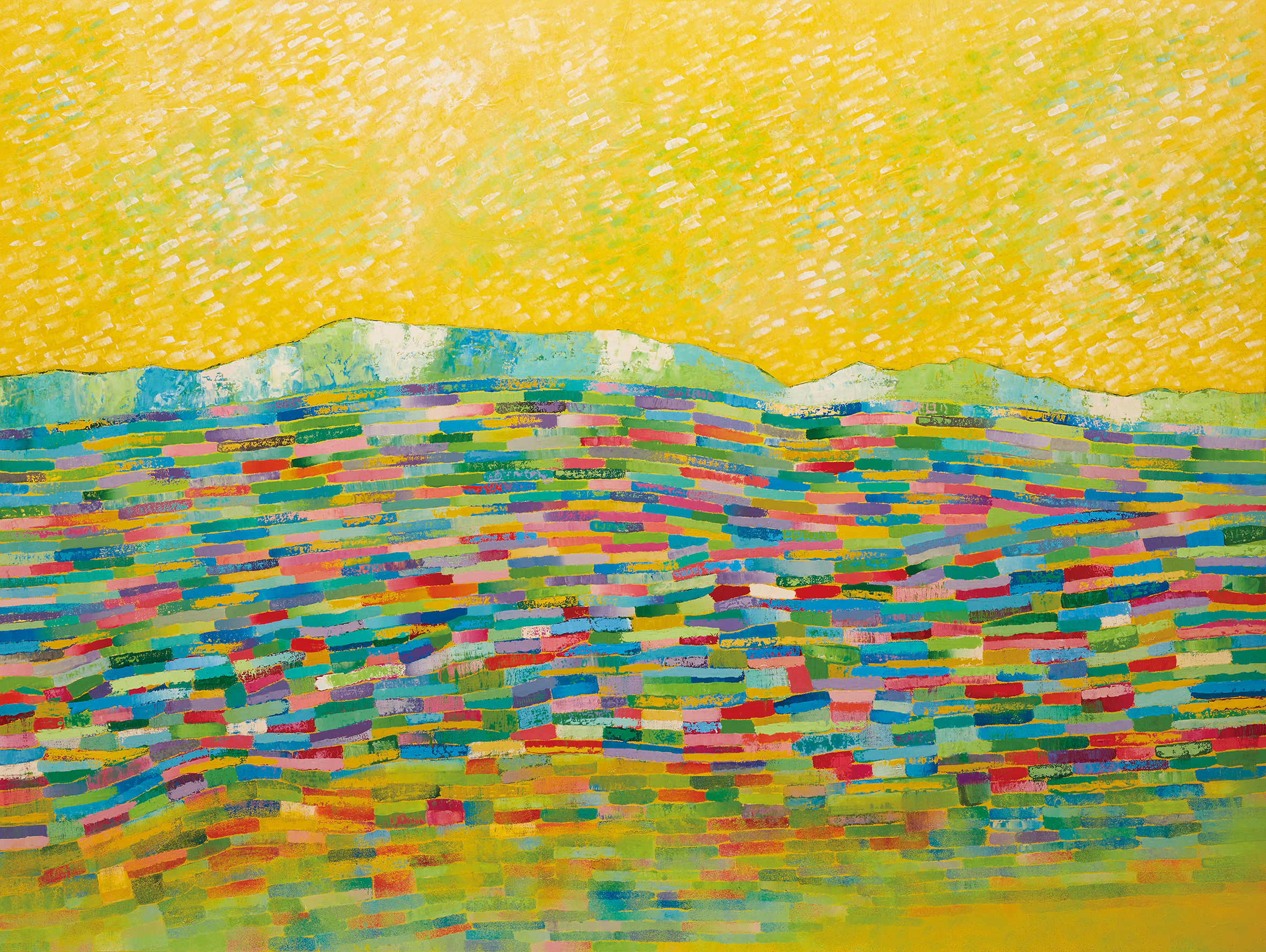
Saekdong is a traditional Korean pattern and design of multi-colored stripes. In Korean, saek means color and dong refers to one stripe or block, so saekdong literally means “stripes of colors.” Mountains and Islands borrows this concept of saekdong to combine individual colored stripes to construct a whole. This reflects the concept from the Avatamsaka Sutra that “each part of a whole contains the whole, and the whole is present in every part,” pointing to the cyclical wonders of nature.

Rimm works with paintbrushes and lacquer spatulas to arrange saekdong in a harmonious array, and at times, she intentionally blurs the boundaries between colors. Depending on the viscosity of ottchil (Korean lacquer) and the speed at which she smudges lacquer paint, the blurring of the borders generates a vibrant sense of rhythm. The boundaries formed by adjoining colors and the disappearance of these boundaries present variations of different colors and textures. This pictorial effect implies a robust sense of temporality and alludes to the energy of nature and its ceaseless creation and extinction. 

The repetition and layering of colors makes us confront philosophical notions on the natural circulation of life and death, while also guiding us to experience moments where artistic media and meditation converge. Ultimately, the Mountains and Islands series that gives physical form to ottchil and layers lines and colors demonstrates the potential for landscapes to be expanded. This is the exact moment when mountains become islands and islands become mountains.


Share
Tweet
Pin
Share
No 개의 댓글


Mountains and islands 
Ottchil (Korean lacquer), Hemp cloth on wood 
60x70cm 
2026 


Share
Tweet
Pin
Share
No 개의 댓글


Caesura  
 Ottchil (Korean natural lacquer), Hemp cloth, 
Hanji(Korean mulberry paper) on wood 
 80x80cm 
 2025 

Caesura is a series inspired by Soesokkak Estuary on Jeju Island. Soesokkak Estuary marks the point where Hyodoncheon Stream originating on Hallasan Mountain meets the sea. The estuary’s unique geography goes beyond presenting a landscape—it reflects the narrative of “encounter and pause” that emerges at life’s turning points.
 
Chae uses the colors of ottchil and textures shaped by the three-dimensionality of hanji (traditional Korean mulberry paper) to capture the moment when sea water and freshwater meet. The repeated layering of blue ottchil is more than an act of applying color to hanji—it becomes a record of time submerged beneath the water and an invitation to its depths.
The purple hue that emerges from and permeates the layers of blue visualizes a sense of meditative calm. Meanwhile, the hanji folds created by hand suggest the rippling surface of water and the breath of the earth, revealing the vital energy of the work as a “relief painting” that is both two-dimensional and three-dimensional.

​Caesura poses the visible landscape and invites us to listen closely to the invisible inner voice beyond it.
As viewers pause from the hurried pace of life before the “passage of breath,” shaped by the deep luminosity of ottchil and varied textures of hanji, one comes face to face with the pure and brilliantly radiant self. 

“As the river and the sea meet and empty into one another, becoming alike, the river comes to understand the sea, while the sea, in turn, embraces the river. The caesura (pause) at Soesokkak is a metaphor for self-reflection, a silence that fosters growth, and the process of arriving at an essential insight through that silence. A brief pause and solitude mark the beginning of self-understanding. Caesura is both an ending and a beginning, where the light of encounter and the light of embrace and life flow.”
Excerpt from the Artist’s Statement
Share
Tweet
Pin
Share
No 개의 댓글


The Good Earth 
 Ottchil (Korean natural lacquer), Hemp cloth, 
Hanji(Korean mulberry paper) on wood 
 122x122cm 
 2025

Share
Tweet
Pin
Share
No 개의 댓글


The Good Earth 
 Ottchil(Korean natural lacquer), Hemp cloth, 
Hanji(Korean mulberry paper) on wood 
 60x60cm 
 2025 

Share
Tweet
Pin
Share
No 개의 댓글


The Good Earth 
 Ottchil (Korean natural lacquer), Hemp cloth, 
Hanji(Korean mulberry paper) on wood 
 60x70cm 
 2025


Share
Tweet
Pin
Share
No 개의 댓글


Mountains and islands 
Ottchil (Korean lacquer), Hemp cloth on wood 
122x162cm 
2023 


<Mountains and islands> is a work that repeatedly simplifying lines in nature grant expandability of expression by the saekdong colors. 
Saekdong is a traditional Korean pattern and design of multi-colored stripes. In Korean, saek means color and dong refers to one stripe or block, so saekdong literally means “stripes of colors.” <Mountains and islands> borrows this concept of saekdong to combine individual colored stripes to construct a whole. This reflects the concept from the Avatamsaka Sutra that “each part of a whole contains the whole, and the whole is present in every part,” containing a question to the cyclical wonders of nature.

Preserving the longing for the past that the colors bring on the screen, the combination of the color fields of obangsaek (red, blue, white, yellow, and black) and ogansaek (bright red, light blue, green, sulfur yellow, and violet) revives the vitality of traditional lacquer through the ‘repetition and overlapping’ of paintbrushes and lacquer spatulas.
Rimm works with paintbrushes and lacquer spatulas to arrange saekdong in a harmonious array, and at times, she intentionally blurs the boundaries between colors, repeatedly making the intended and the coincidental intersect. Depending on the viscosity of ottchil (Korean lacquer) and the speed at which she smudges lacquer paint, the blurring of the borders generates a vibrant sense of rhythm. The boundaries formed by adjoining colors and the disappearance of these boundaries present variations of different colors and textures. This pictorial effect implies a robust sense of temporality and alludes to the energy of nature and its ceaseless creation and extinction. 

In this way, although Rimm’s color field paintings appear simple with their refined expressions, her reiterative actions stimulate a tranquil sense of vitality. As such, nature’s cyclical narrative, in which the principles of giwunsaengdong (the spirit lives and moves) and jeongjungdong (movement in silence) are in harmony, breathes in them.

The repetition and layering of colors makes us confront philosophical notions on the natural circulation of life and death, while also guiding us to experience moments where artistic media and meditation converge. 
The <Mountains and islands> series that gives physical form to ottchil and layers lines and colors demonstrates the potential for landscapes to be expanded. This is the exact moment when mountains become islands and islands become mountains.

Share
Tweet
Pin
Share
No 개의 댓글

The Good Earth 
 Ottchil (Korean lacquer), Hemp cloth, 
Hanji(Korean mulberry paper) on wood 
 122x122cm 
 2024 

CHAE, Rimm's fresh take on the traditional technique of jitae ottchil, which involves layering hanji (Korean mulberry paper), conveys a sense of contemporary aesthetics in the underlying Korean sentiment. 

Jitae ottchil is an ancient technique of using hanji in traditional Korean lacquerware craft that flourished during the Goryeo and Joseon dynasties. The origin of hanji goes as far back as the Three Kingdoms Period in Korean history, and traditional hanji is defined as “hand-scooped paper made mainly with the bark of mulberry trees grown on Korean soil.” There is a saying that while silk only lasts 500 years, hanji survives a millennium, with its 1,000-year durability proved by the oldest existing woodblock print copy of the Great Dharani Sutra. 

The Good Earth 
 Ottchil (Korean lacquer), Hemp cloth, 
Hanji(Korean mulberry paper) on wood 
 60x70cm 
 2024 


The Good Earth reveals unique kyeo (layers) and gyeol (grain) on the canvas through repeated hanji folds and the layering of colors. Along with the idea of accumulation, kyeo and gyeol are important elements in understanding this series. Kyeo refers to consistent layering that results from the assemblage of solid and soft elements of nature such as trees and rocks, and the texture or pattern they create is known as gyeol. 

Through the repeated grain of hanji and ottchil, Rimm constructs paintings that convey layers of time. The natural continuations and breaks of thick and thin folds demonstrate kyeo and gyeol on the two-dimensional pictorial plane, and then work to create a three-dimensional space of painting that implies the temporality of nature that witnesses the continuous cycle of life and death. In other words, the repetitive action of creating hanji folds using the contemporary application of traditional jitae ottchil is both a process of reflecting her inner contemplation through the embodiment of ottchil work and a practice of internalizing temporality.

The Good Earth 
 Ottchil (Korean lacquer), Hemp cloth, 
Hanji(Korean mulberry paper) on wood 
 27x35cm x2ps 
 2024 


Rimm expresses linear forms from nature such as ridges, trees, roots, and strata through varied forms and thicknesses of hanji folds. In doing so, she encompasses the energy that flows between the dichotomies of two-dimensional and three-dimensional, traditional and contemporary, intended and coincidental, and real and imaginary, which works to visually expand her art. Lines that embody natural forms come to resemble brushstrokes in ink-and-wash paintings through the hanji folds, while their colors gain volume and the beauty of negative space is magnified.

In the end, the artist arrives at contemplation and meditation on nature through her repetitive work of creating each hanji fold and layering ottchil over it. The subtle sense of volume and texture created by the creases and folds on her canvas ultimately takes us to a serene world of Eastern nostalgia.
Share
Tweet
Pin
Share
No 개의 댓글


Arirang Cantabile
 Ottchil (Korean lacquer), Hemp cloth,
Hanji (Korean mulberry paper) on wood
  20x20cm x15ps
  2023-2024

<Arirang Cantabile> is a series of works that reinterprets traditional color schemes from a contemporary perspective, drawing attention to Korean aesthetics and sentiments of nature through simple composition and semi-abstract expressions.

Rimm uses blends and combinations of obangsaek and ogansaek color schemes and creates “piles” of colors by repeatedly layering one over the other with paintbrushes, lacquer spatulas, and palette knives. Sometimes, she borrows from the concept of saekdong, and at other times, she adopts the aesthetic concept of jogakbo (Korean traditional patchwork). From relationships in life to the cycles of nature and harmony between humanity and the environment, various Asian philosophies are implied in the multitude of colors and artistic characteristics of this series. Her language of colors embraces visual sensibilities and deep contemplation, creating diverse moving scenery.

Arirang Cantabile
 Ottchil (Korean lacquer), Hemp cloth,
Hanji (Korean mulberry paper) on wood
  20x20cm x30ps
  2023-2024


The landscapes in each painting demonstrate expandability, repeating change after change. The key motif of the series, “mountains and islands,” is expressed in various colors and lines, transforming the pictorial planes into tranquil meditative spaces. The islands make their presence known through the sea, and each island stands unique in relation to the other islands. Yet, underwater, the islands eventually constitute one large mountain, connected like mountains on land. This motif of “mountains and islands” links freely to time and space, offering expandability to both the series and media.
The landscapes on each piece stand on their own, but together as a series, they constitute one lyrical “saekdong landscape painting” that unfolds like a massive folding screen. 

This particular form of the work results from <Arirang Cantabile> originating as an étude (study, research) project. Small landscapes made by collecting snippets and fragments of thoughts and then conducting various experiments with ottchil entail the possibility of expansion to any size at any time. In fact, <In the Midst of Life> and <The Good Earth>, presented in the first and second sections of the exhibition, respectively, are the fruits of expanded observation and reflection on <Arirang Cantabile>.

Share
Tweet
Pin
Share
No 개의 댓글


Mountains and islands 
Ottchil (Korean lacquer), Hemp cloth,
 Hanji(Korean mulberry paper) on wood 
60x70cm 
2023 


Mountains and islands 
Ottchil (Korean lacquer), Hemp cloth on wood 
60x70cm 
2022

 
Mountains and islands 
Ottchil (Korean lacquer), Hemp cloth on wood 
60x70cm 
2023 

Share
Tweet
Pin
Share
No 개의 댓글


Musing forest 
Ottchil (Korean lacquer), Hemp cloth,
 Hanji(Korean paper) on wood 
60x70cm 
2024 


Musing forest 
Ottchil (Korean lacquer), Hemp cloth,
 Hanji(Korean paper) on wood 
60x70cm 
2024


Share
Tweet
Pin
Share
No 개의 댓글
Arirang Cantabile
 Ottchil (Korean lacquer), Hemp cloth on wood
  20x20cm  162ps
  2019-2022

 
Chae, Rimm has been creating “sculptural painting” based on the use of ottchil, or Korean lacquer, and mother-of-pearl. She also demonstrates the novel potential of ottchil as pure fine art through her lacquer landscape paintings. At the exhibition “PERSONAL STRUCTURES,” she will present variegated fantasies of ottchil through her art project Arirang Cantabile. “Arirang,” is a lyrical folk song of Korea, inscribed on the Representative List of the Intangible Cultural Heritage of Humanity in 2012 in recognition of its Outstanding Universal Value. Recently, BTS’s cover of “Arirang” has transformed this traditional folk number into a global sensation.

Her artwork reinvents Korean sensibilities and landscapes conjured up by “Arirang” through inner imagery. A polyptych comprising some 160 panels, it recreates the elements of traditional aesthetics (lines, colors, and empty spaces) with a modern twist and her unique insights. She uses creative lines based on the traditional color schemes known as obangsaek and ogansaek. As she notes, “The yellow, blue, red, white, and black hues that constitute obangsaek are beautiful colors reflecting the principles of nature.” A designer of traditional accessories, she evokes oriental moods in her works and ponders over the temporality of colors — a concept that forms the spiritual root of traditional Korean paintings. She mixes colors, peels them off, reinterprets them, and redesigns them while revealing the innate texture of lacquer. She sometimes employs vivid primary colors, fills the panel with light and soft pastel tones, or expresses depths using achromatic colors. Her work, which encompasses diverse contrasting values (e.g. the traditional and the contemporary, the East and the West, and light and darkness), leaves lingering feelings amid the juxtaposition of the simple and the profound as well as the bold and the delicate.


Through real and recalled scenery crossing between the figurative and the abstract in the connotative language of colors, her work manifests both restrained innocence and refined glamour. Oriental philosophical concepts, such as relationships in life, circulations in nature, harmony between humans and nature, are embedded in varying hues and simplified landscapes. Her language of colors embraces visual sensibilities and deep contemplation, creating diverse moving scenery.

Using native Korean materials, such as hemp cloth and paper, she expresses a differentiated aesthetic while exploring a new sculptural language by utilizing modern jewelry as objets d'art on the lacquered panels. This is not only an aesthetic achievement resulting from her delicate attention to landscapes but also an outcome of her efforts to reproduce Korean imagery using a modern sculptural language.

Each landscape vignette (e.g. mountains, an island, the sea, and the sky) that unfolds on a 20x20cm wood panel combines to create a dynamic panorama.  Each of the 160 panels exist independently but together provide the viewer with an epic, lyrical fantasy. The polyptych will invite us to explore diverse lacquering techniques and hues, experimental spirit of materials, humanistic concepts and the philosophy of color through the communion between the traditional and the modern.

Share
Tweet
Pin
Share
No 개의 댓글


In the Midst of Life
Ottchil (Korean lacquer), Hemp cloth,
 Hanji(Korean mulberry paper) on wood
30x60cm x5ps
2023-2024


<In the Midst of Life> accentuates the charming spectrum of blue hues while horizontally dividing the canvas into two, naturally creating and addressing binary oppositions of contrasting concepts such as real and non-real, figurative and abstract, and East and West.

The variation of colors that demonstrates both the fusion and autonomy of different tones of blue, unique matière and sensuous blank spaces created by ottchil and hemp cloth, and repetition of brushstrokes building up in layers give form to the principles of nature, generating an aesthetic language that resonates among and within us.

Through the islands that appear in every canvas, Rimm creates a powerful metaphor for life, that we sometimes live independently and in the company of others, with the overall composition of each island both standing on its own and functioning as a part of the whole. At times, she carries on the spirit of dansaekhwa (monochrome painting), which focuses on “the layering of time and repetitive action,” while also demonstrating the artistic method of incorporating figurative elements by simplifying the expression of the islands. 

In the Midst of Life
Ottchil (Korean lacquer), Hemp cloth on wood
60x70cm
2024


In the Midst of Life
Ottchil (Korean lacquer), Hemp cloth,
 Hanji(Korean mulberry paper) on wood
60x70cm
2024


The artist’s deepening reflection on pristine landscapes guides her to simplify both the composition and color of her paintings as she further develops her work. This imparts the value of wuwei (non-doing), in which we clear our minds and leave everything up to nature, thus following its order.

By painting islands on a space of depth created by layering colors, Rimm transforms her canvases into planes of sensuous and abstract images as well as in-depth ontological exploration. The islands expressed through changes in the density and humidity of ottchil convey the spirits of silence in movement and movement in silence (dongjungjeong and jeongjungdong). 
Share
Tweet
Pin
Share
No 개의 댓글


Mountains and islands 
Ottchil (Korean lacquer), Hemp cloth,
 Hanji(Korean paper) on wood 
122x162cm 
2023 


<Mountains & Islands> is a bold, sensual “saekdong (multi-colored stripes) landscape painting” created with conceptual colors that reflect the Korean sentiment and the hues and stripes of saekdong. “Dong” refers to a single color stripe, and by juxtaposing stripes of complementary or similar colors, I create a brilliant and tense image. As these color bands repeatedly overlap and continually extend, they blur the boundaries between center and background, figurative and abstract, and traditional and contemporary, while generating a refined sense of beauty and resonating aesthetic language. 
Share
Tweet
Pin
Share
No 개의 댓글
Older Posts

recent

recommend

  • Symbolism in Poetry by Lacquer Painting
    by Yongwoo Lee

  • Popular Posts

    • Symbolism in Poetry by Lacquer Painting
    • The Good Earth
    • Mountains and islands
    • The Good Earth
    • The Good Earth

    SNS

    Contact

    Name

    Email *

    Message *

    Copyright © Rimm Chae
    rimmchae@gmaiil.com

    Created with by BeautyTemplates